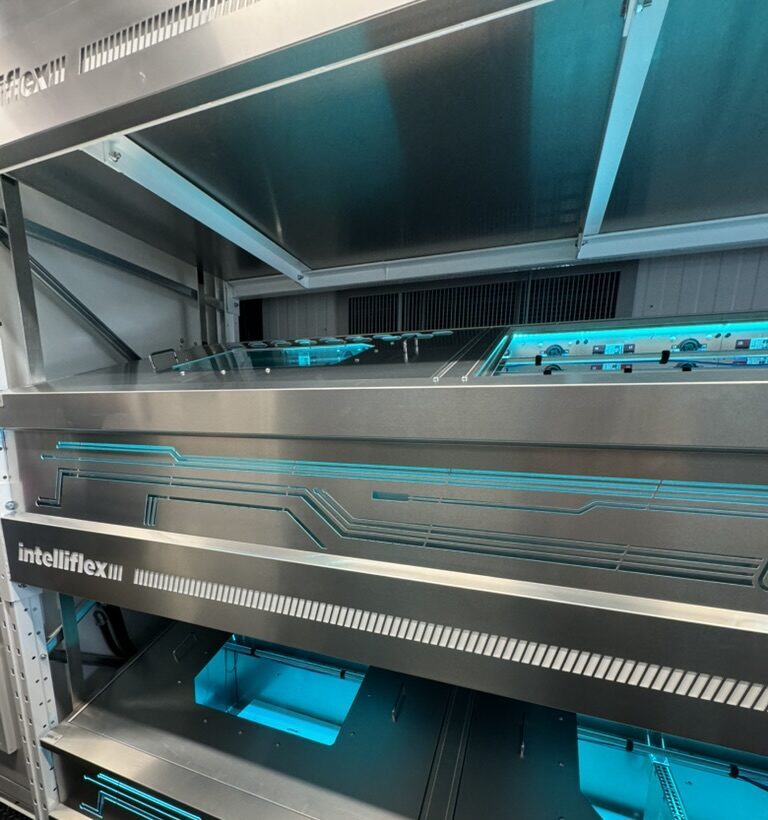
What is a Bitcoin mining container?
What is a Bitcoin mining container? A Bitcoin mining container is a customized container that integrates the power distribution, network, cooling, and rack systems required for Bitcoin mining. Bitcoin mining containers are divided into three types based on the miner cooling method: 1. Air-cooled Bitcoin mining containers, 2. Liquid-cooled Bitcoin mining containers, 3. Immersion-cooled Bitcoin mining containers.Each type is further divided into 40ft and 20ft sizes to adapt to different site areas and transformer capacities (all mining containers must match the transformer capacity appropriately; if the transformer capacity is large but the container power consumption is small, it is a waste; if the transformer is small but the container power consumption is large, it cannot run at full load).
Three Types and Specifications Comparison
| | 40ft | 20ft |
| Air-cooled Bitcoin mining container (There will be differences depending on miner models) | Can run 315–360 units, power consumption 1MW–1.2MW | Can run 144–189 air-cooled miners, power consumption 0.5MW–0.75MW |
| Liquid-cooled Bitcoin mining container (There will be differences depending on miner sizes) | Can run 240–420 units, power consumption 1.7MW–2.5MW | Can run 120–210 units, power consumption 1.2MW |
| Immersion-cooled Bitcoin mining container (There will be differences depending on sizes) | Can run 160 units, power consumption 1.6MW | No 20ft version available yet |
Air-Cooled Bitcoin Mining Container Components and Procurement Points
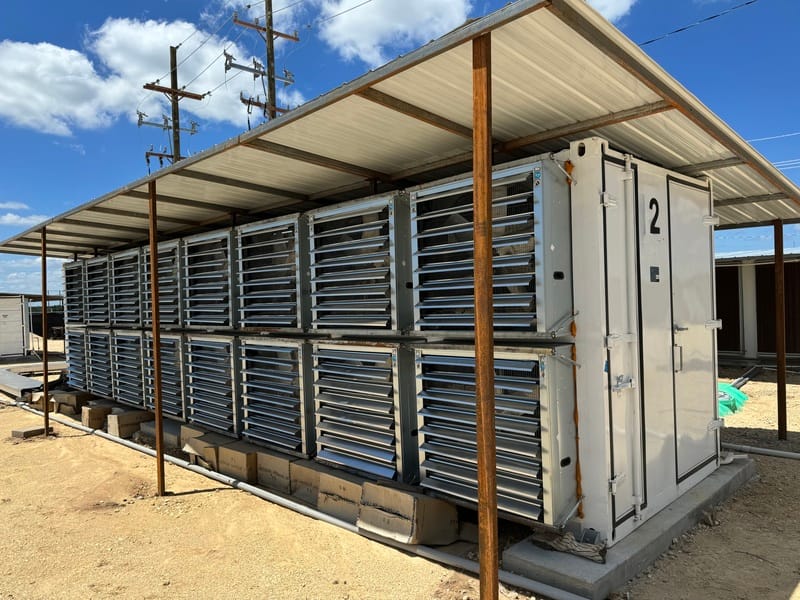
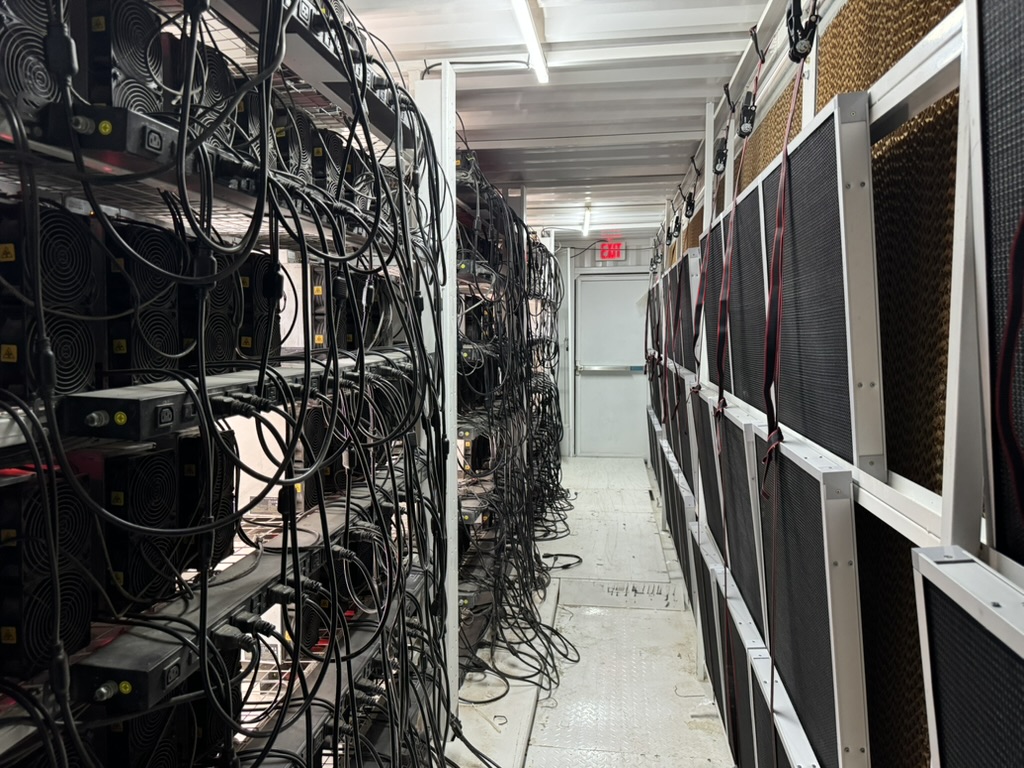
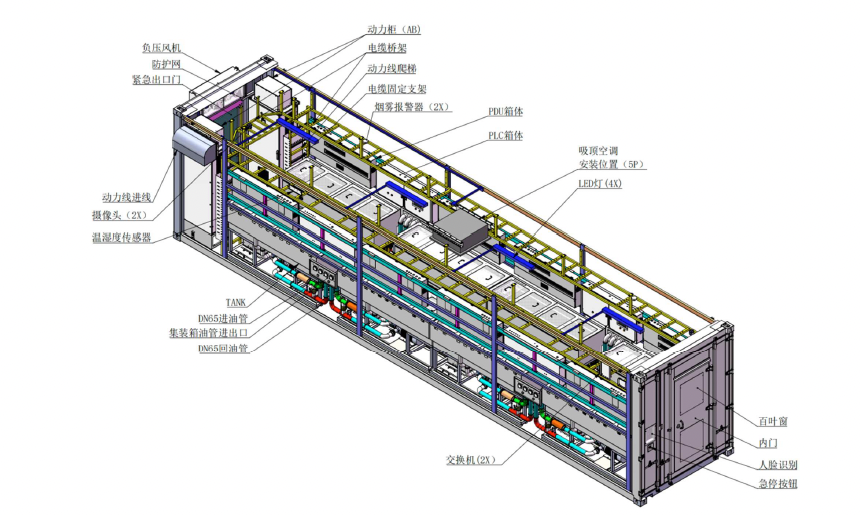
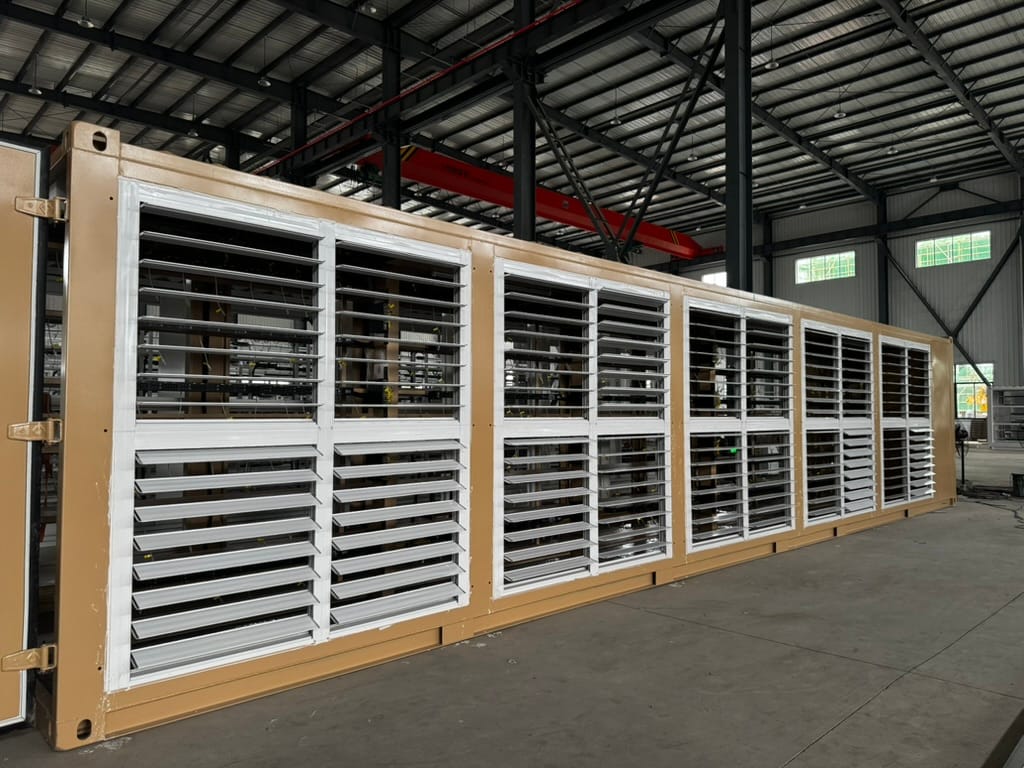
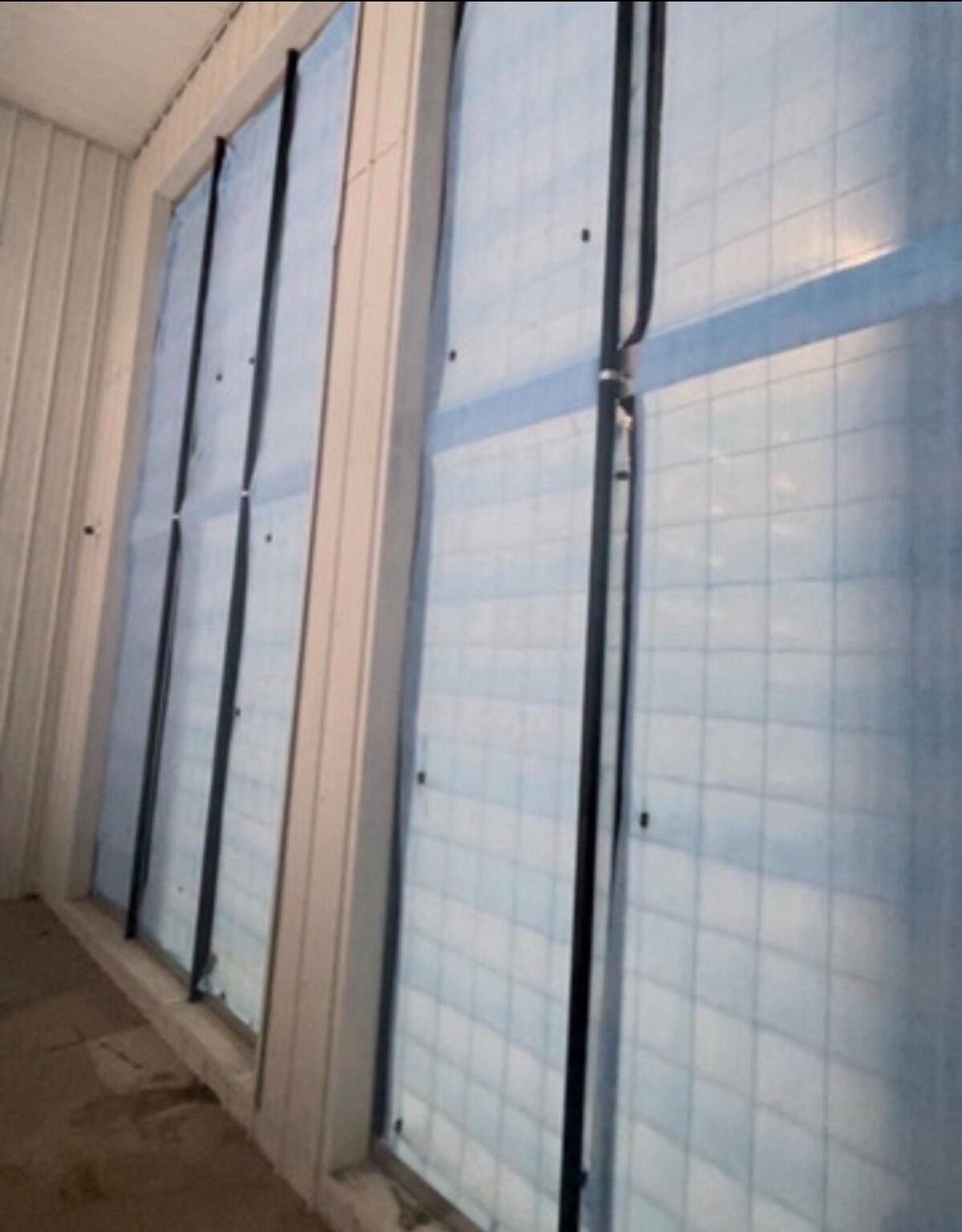
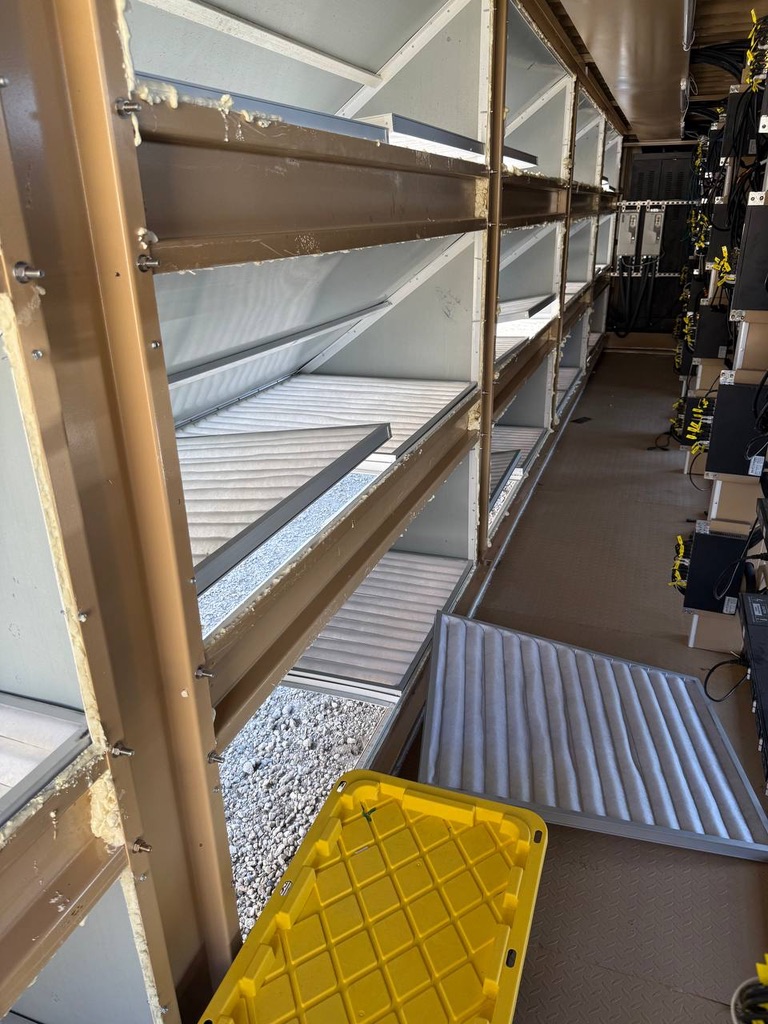
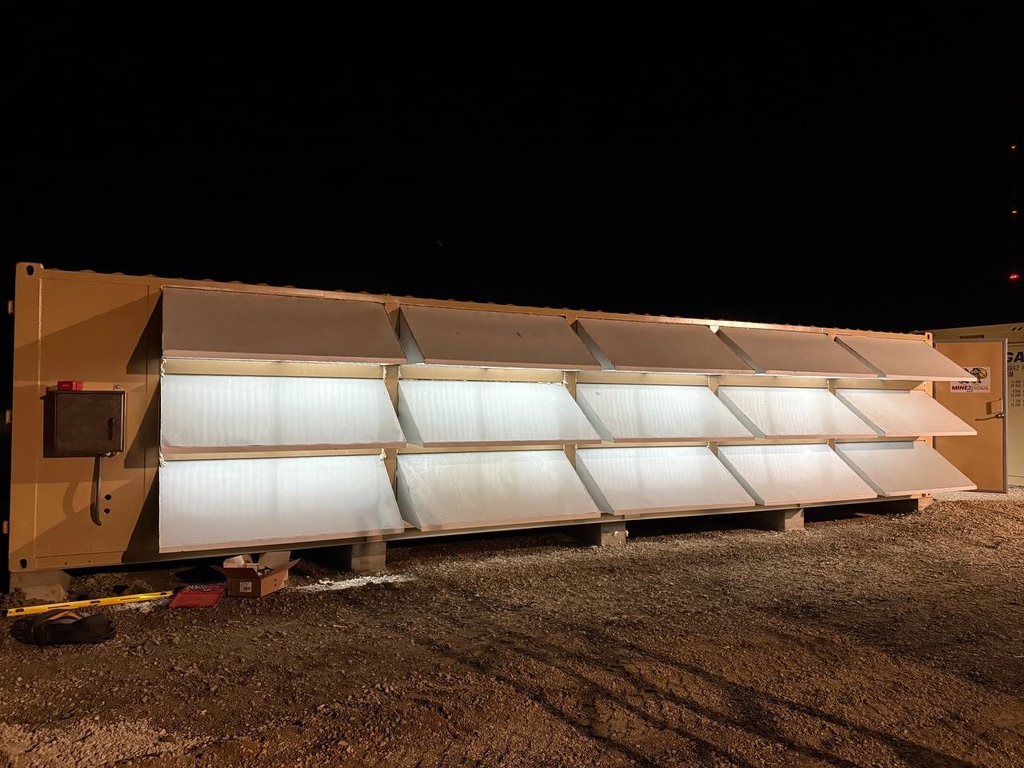
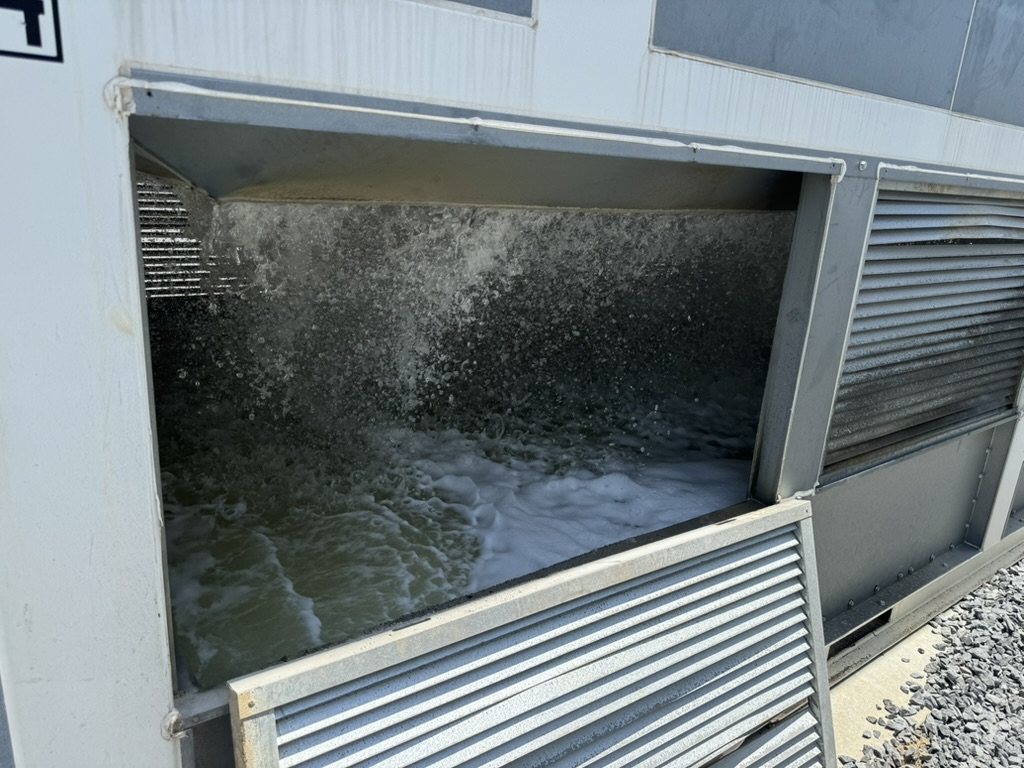
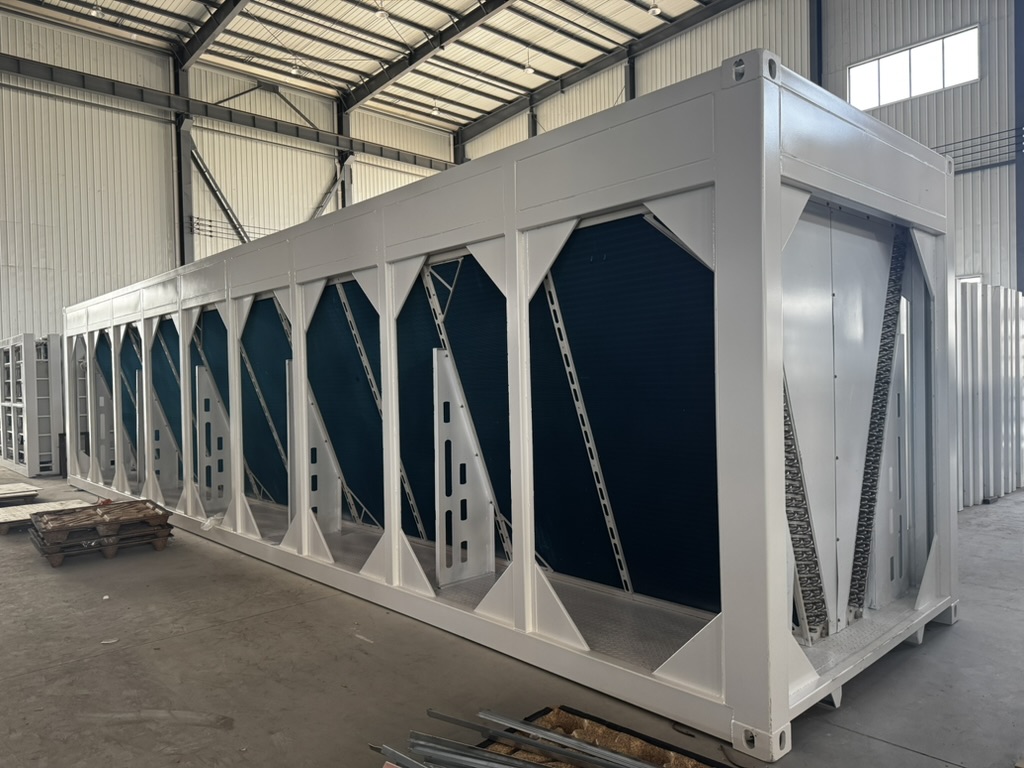
The interior of an air-cooled Bitcoin mining container usually consists of: power distribution cabinet, PDU, cables, racks, switches, and network cables. The exterior is in the shape of a container, with large exhaust fans mounted on the left wall and water curtains or other air intake filters (louvers, filter cotton, etc.) on the right wall. The middle has racks running the miners. Cool air is drawn in from the right side by the miner fans, and hot air is exhausted by the miner fans and then drawn outdoors by the large exhaust fans.
Air-cooled mining containers have the simplest internal structure among the three types and are also the lowest priced. When choosing, pay attention to the following points:
1. Cooling design must be reasonable Air-cooled mining containers are the most prone to causing high miner temperatures because there are many machines inside the container and cooling relies entirely on air. If the internal airflow design is unreasonable, it will cause local high temperatures, with hot air being sucked back in. This usually manifests as high temperatures on the bottom and top layers of machines, in front of machines with obstacles, or in corners.
2. Three-phase balance Air-cooled miners are usually 220V. The PDU and power distribution cabinet design inside the mining container must consider A, B, C three-phase balance. When on-site operators rack the machines, they must also ensure the number of machines on each phase of the PDU is consistent. Severe phase imbalance can cause power failures, damage machines, or even injure personnel.
3. Whether it has LSIG protection (in compliance with local regulations) All air-cooled mining containers should follow the TN-S power system. Therefore, a circuit breaker with LSIG four-stage protection function must be installed at the connection between the transformer and the mining container’s power distribution cabinet, selected according to power consumption. For example, for a 1.2MW power consumption mining container, a 2500A frame circuit breaker is recommended. It can be installed inside the mining container’s power distribution cabinet or separately on the transformer side. Regulations vary by country. For example, Canada requires frame circuit breakers. Our ARK5000Pro model 40ft mining container’s Canada version has overall CSA SPE1000 special inspection certification, and the certification engineer required a UL or CSA certified 2500A frame circuit breaker to be configured inside the mining container’s power distribution cabinet. The LSIG protection function can minimize electrical risks and protect personnel safety.
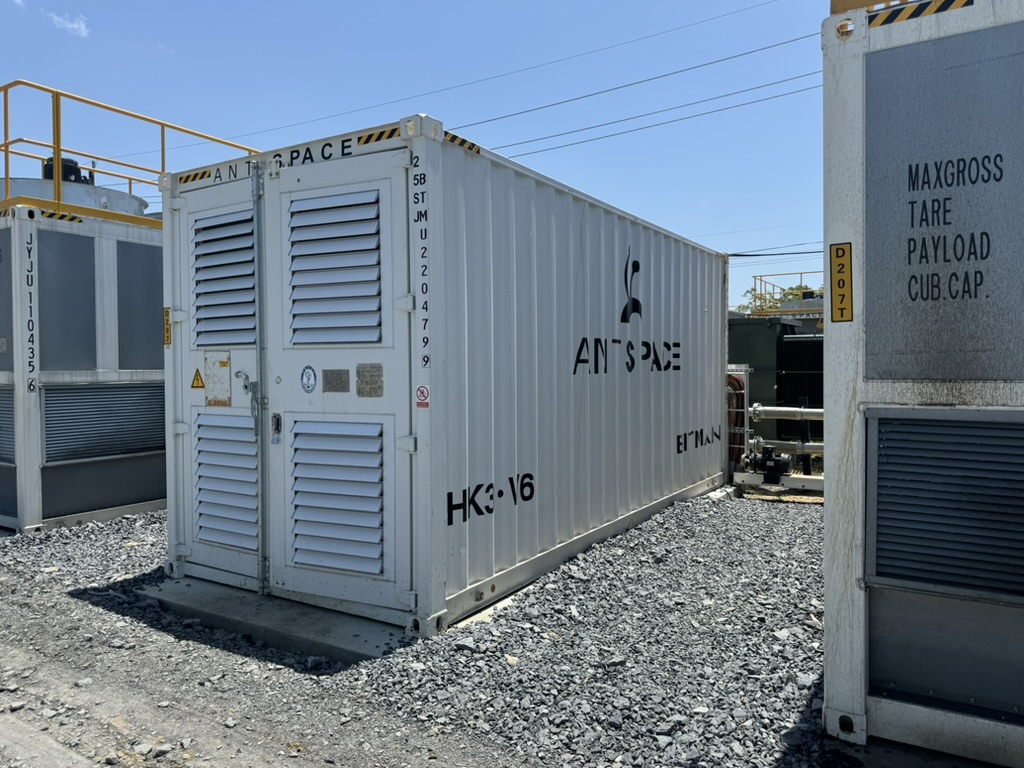
Air-cooled Bitcoin mining container and its interior:
Liquid-Cooled Bitcoin Mining Container Components and Procurement Points
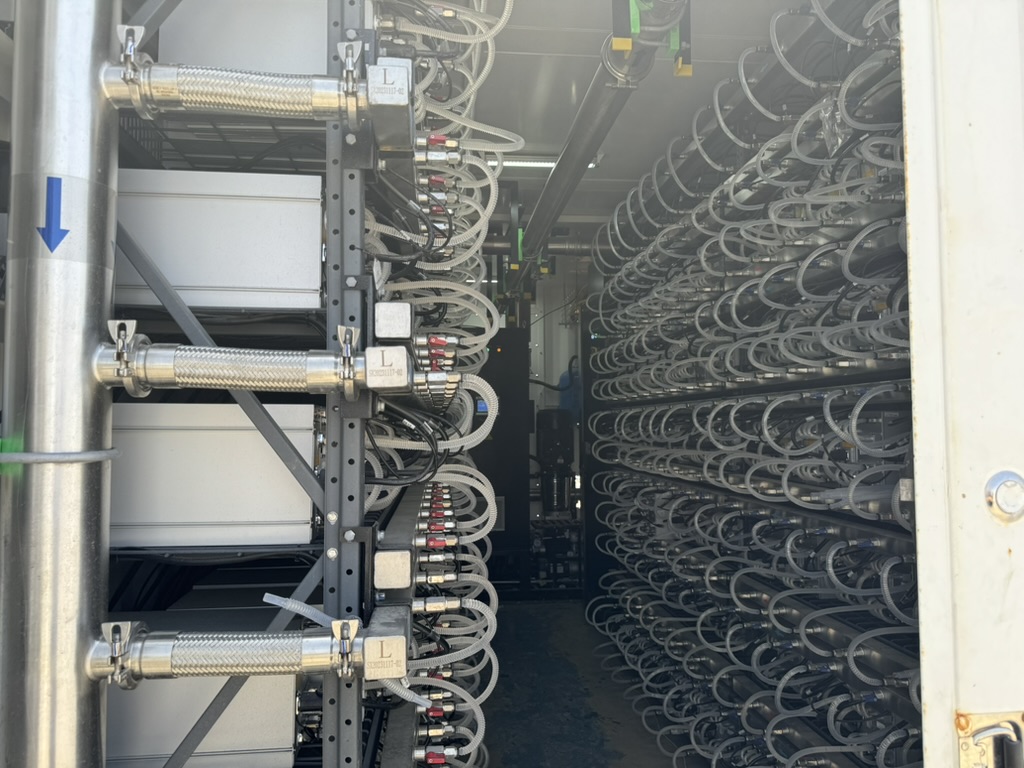
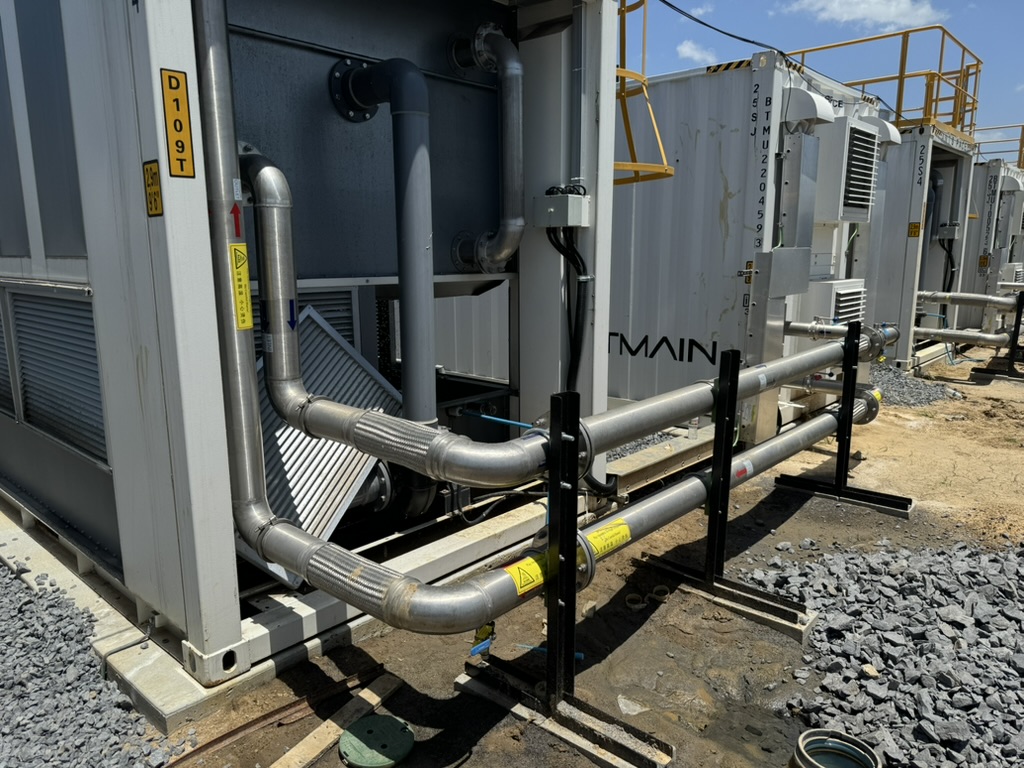
The interior of a liquid-cooled Bitcoin mining container usually consists of: UQD, corrugated pipes, stainless steel water distributors, stainless steel cold water pipes, stainless steel hot water pipes, CDU pump unit, power distribution cabinet, and cables. Usually, one liquid-cooled container is paired with one dry cooler or closed cooling tower to dissipate heat from the miners’ cooling water. Because liquid-cooled miners use cold plate cooling, the cooling medium is basically pure water, so it is also called water cooling or hydro cooling.
Liquid-cooled mining containers are currently the most popular, with many varieties on the market. The following are procurement suggestions:
1. Whether the design meets the requirements of the miner’s user manual The mainstream liquid-cooled miner manufacturers on the market currently include: Bitmain: Antminer S series, 2U series, 3U series; Microbt: Whatsminer M63, M73, 2U series; Canaan: Avalon 2U series. Each product has its user manual, which details the operating requirements for liquid-cooled miners. For example, Whatsminer’s liquid-cooled miner documentation specifies that stainless steel water pumps and stainless steel pipes must be used, and a 100-mesh main pipe filter and 10-micron bypass filter are required. If the mining container you choose does not meet the requirements in the product manual, the miner manufacturer will refuse warranty.
2. Whether the CDU is reliable The CDU, also known as the pump station, is the heart of the liquid-cooled mining container. If it stops, the entire system will be paralyzed. Choosing a good CDU means choosing stable revenue. How to select a good CDU? Check whether the internal core control electrical brands are first-tier big brands. For example, in our Ant420 liquid-cooled mining container, the CDU internally uses ABB inverters, Siemens PLC, and Mean Well regulated power supplies, which can reduce the failure rate.
3. Check whether the water pump has a backup option. If the water pump fails, the entire mining container will stop running, causing serious losses. Our Ant420 liquid-cooled mining container uses 2 water pumps inside—one running and one backup. In case of failure, it will automatically switch to the other immediately and supports non-stop maintenance and custom timed switching.
4. Check whether the system logic is simple and reliable. Liquid-cooled mining containers are industrial products; normal operation and long-term stable operation are the most important. Fancy functions will only increase the failure rate. When purchasing, asking the seller to explain the operating logic once is more useful than looking at any electrical diagram.
5. Whether the dry cooler design is reasonable The dry cooler is equivalent to the skin that regulates body temperature. Without the dry cooler for heat dissipation, the miners cannot operate normally. The core points for selecting a dry cooler: 1. Whether the dry cooler material is suitable for the operating environment? Tell the manufacturer your project location, whether there are pollutants, corrosion, etc., and let them customize it for you. There is no single dry cooler suitable for all environments worldwide—this is not an iPhone.
6. Ask the manufacturer what the outlet water temperature of the dry cooler is during the hottest time? This is very important. The miners used have a maximum inlet liquid temperature limit. Also ask the manufacturer whether a water curtain is needed for auxiliary cooling.
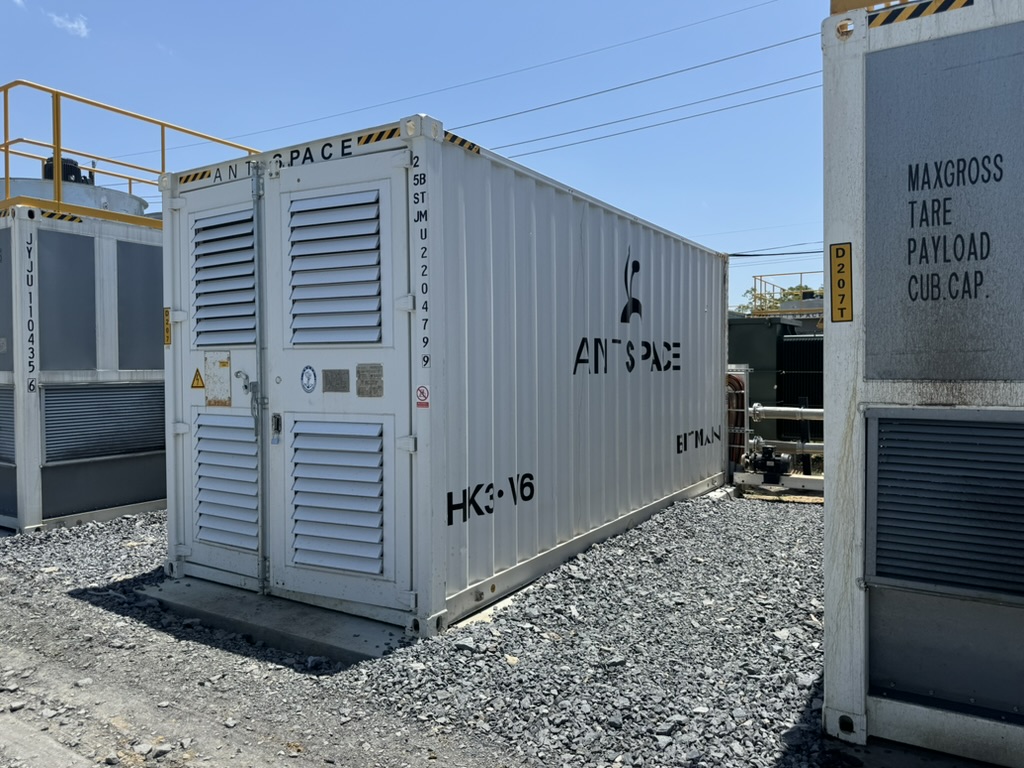
Liquid-cooled Bitcoin mining container and its interior:
lmmersion-Cooled Bitcoin Mining Container Components and Procurement Points
The interior of an immersion-cooled Bitcoin mining container usually consists of: stainless steel Tank (internally integrated PDU, flow equalizer plate, water pump, etc.), CDU control system. Usually, one immersion-cooled container is paired with one dry cooler or closed cooling tower to dissipate heat from the miners’ insulating cooling liquid. Immersion cooling submerges the miners completely in the Tank and must use insulating oil for cooling. Currently, all are single-phase immersion cooling.
Immersion-cooled mining containers are currently the best at operating in extreme environments. The current market circulation is very small, and there are only 4 models of immersion-cooled miners: Bitmain: S21 XP Imm, S21 Imm; WhatsMiner M66, M66S. The following are procurement suggestions:
1. Choose the cooling liquid recommended by the miner manufacturer—this point is especially important.
2. The manufacturer must have actual immersion-cooled operation cases for reference.
3. At this stage, try not to choose immersion-cooled miners, as it is easy to become a guinea pig.
Immersion-cooled Bitcoin mining container and its interior:
Why Use Bitcoin Mining Containers Instead of Building Structures?
Conclusion first:
- Shorterconstruction period and lower cost
- Movable (mobile mining)
- Simpler (easy scaling)
1. Using Bitcoin mining containers has the fastest overall construction period and the lowest cost for small-scale construction. Unlike data centers that start at hundreds of MW, most Bitcoin mining farms are usually around 10MW, 20MW, or 30MW. The scale is small and, in order to obtain cheap electricity, 90% of Bitcoin sites are in remote wilderness far from cities and towns. If you build a plant specifically for this project, the cost is high and the approval period is very long. Therefore, you will find that small-scale sites all use Bitcoin mining containers, but projects exceeding 100MW mostly build structures.
For example: Our Texas 32MW air-cooled site uses 32 units of 40ft Bitcoin mining containers. From land leveling to miner racking and power-on, it only took 80 days, with a cost of approximately $130,000 per MW (excluding miners).
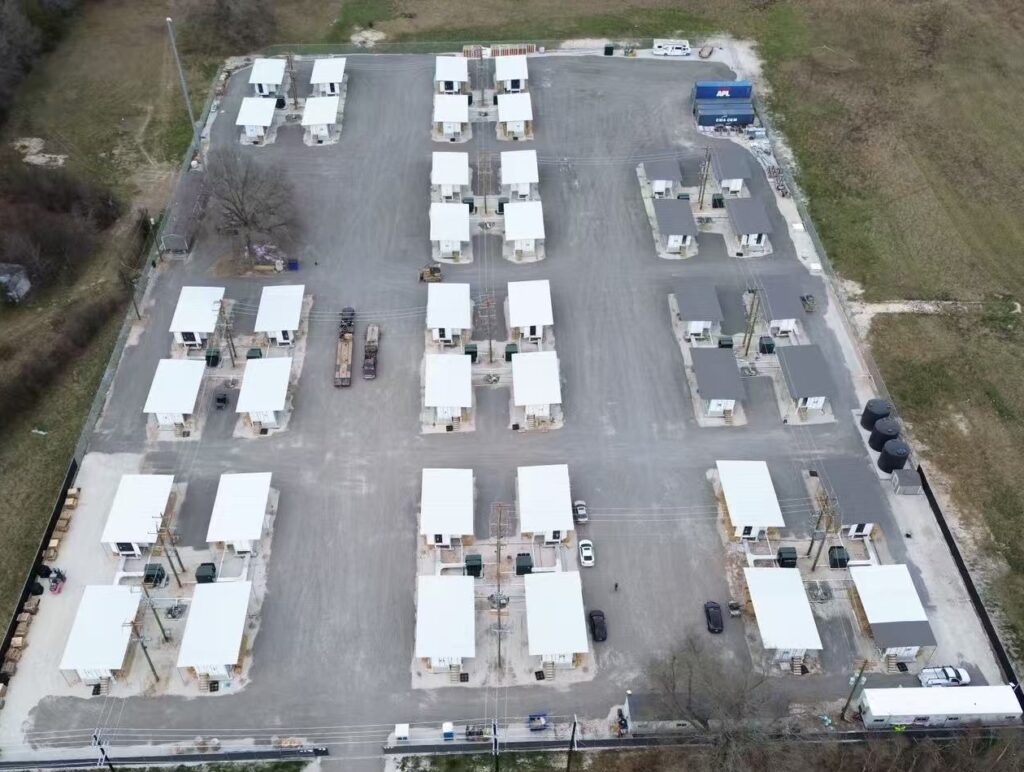
Texas 32MW mining container site vs traditional plant
Hut8 300MW Vega project will require an investment of $2.5 billion and the overall cycle takes more than 2 years.
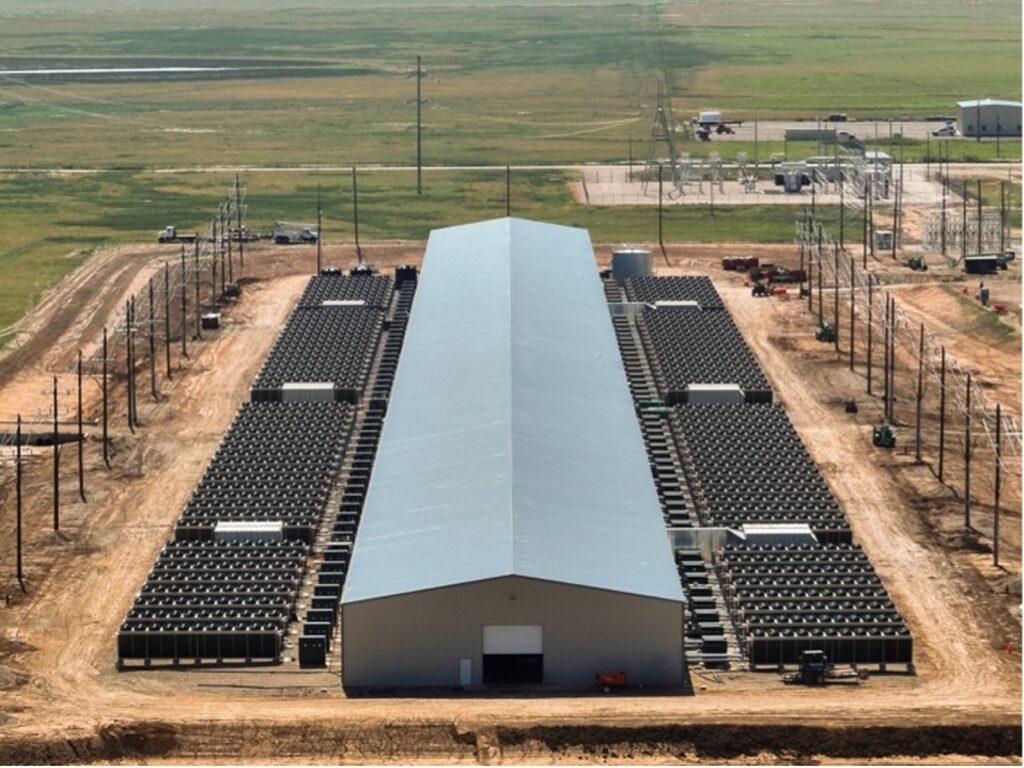
This is the plant built by Hut8, all using Bitmain 3U liquid-cooled miners, with a single site scale exceeding approximately 15 EH/s.
2.Mining containers are movable (mobile mining).
As mentioned above, most mining farm scales are not large, and power and land contracts are basically for three years. Upon expiration or when the market is good, they may be resold. Sites built with mining containers can basically be transferred intact to another site and continue operating—this cannot be achieved with built plants.
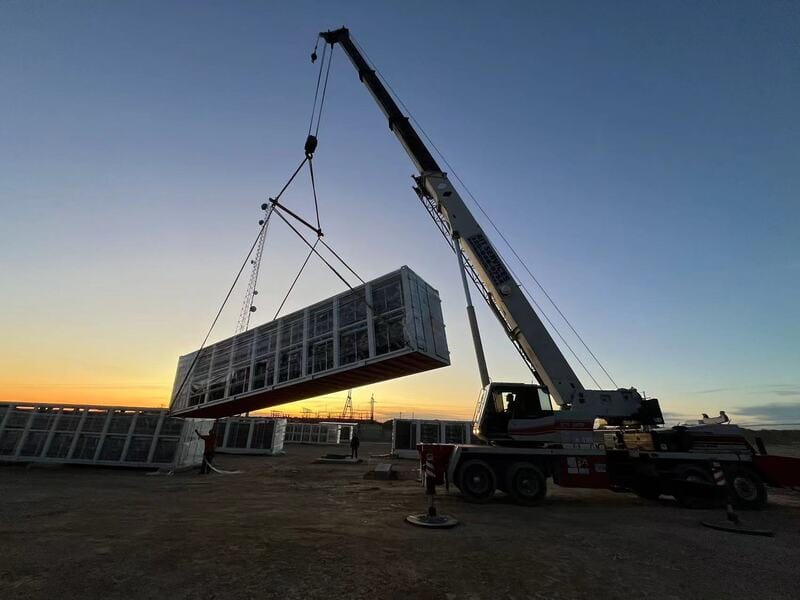
3.Using mining containers is simpler.
Most investors and operators may not have had mining operations experience before. If designing a complete set of power, cooling, plant, and network systems from scratch, many more personnel will need to be hired, and transporting these components to the site and installing them according to drawings will be a very cumbersome project. A mining container is a highly integrated and standardized product that eliminates the above work. Operators only need to connect the transformer to the mining container, and everything is complete! There is also no need to worry about certification, fire protection, power safety, and other risks.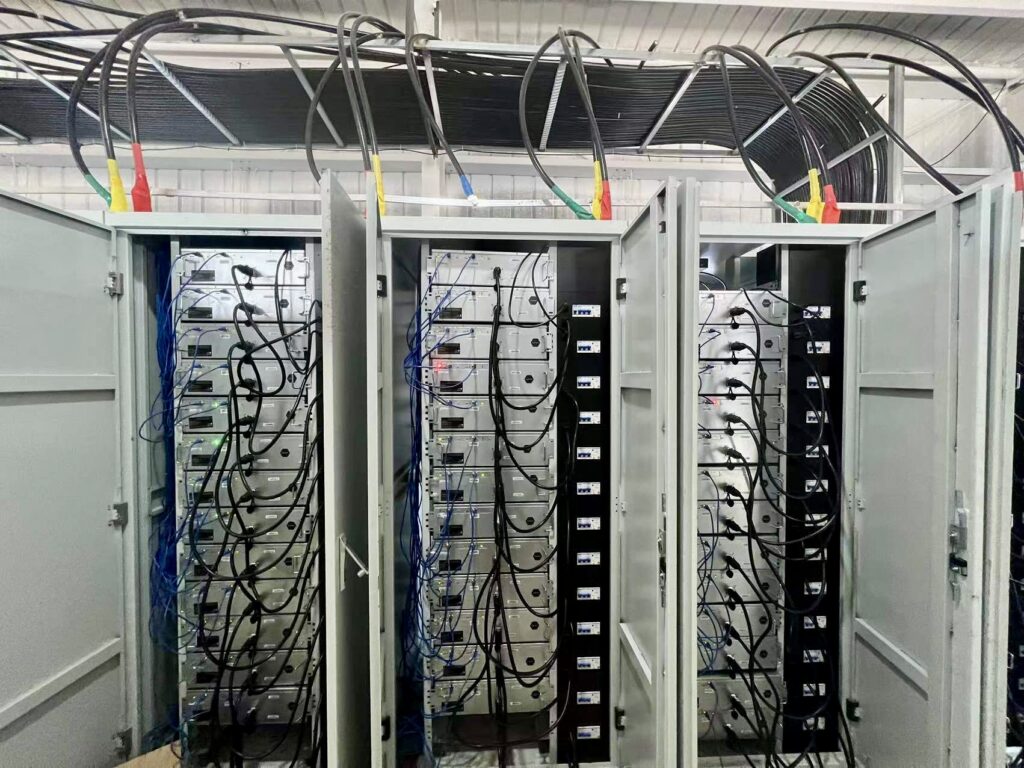
Actual Case: How to Choose Mining Containers for Specific Countries/Climates
Case 1: Alberta Province, Canada. Year-round temperature from -14°C to 24°C, with blizzards and summer highs of 25°C (extreme 30°C). Using Bitmain’s latest air-cooled miner S21XP. The client has already purchased the transformer and requires the mining container to have a maximum power of 1.2MW.
Analysis: In terms of climate: Because the temperature is low year-round, no water curtain is needed for cooling. Only a canopy needs to be added to avoid high temperatures for a few days in summer. The site has no water, saving a lot of trouble. The specified maximum power indicates power experience, so we can proceed according to requirements.
Conclusion: Design the mining container overall according to the maximum power of 1.2MW for miner capacity. For cooling, use adjustable louvers + cleanable filter cotton on the air intake side, with cold-hot isolation sealing for the cold air and hot air zones. Use enhanced direct-drive fans + inverters to reduce fan power consumption in winter. Install a triangular canopy on the top of the mining container, raised 50cm in the middle and extending 2 meters to the left and right sides respectively. Add a 50mm insulation layer on the container top, which can effectively prevent high temperatures from direct summer sunlight. For certification, overall CSA certification must be obtained.During heavy snowfall, triangular snow hoods with filter cotton can be installed on the outside of the blinds to effectively block the snow.
Benefits: This solution can save a lot of later maintenance costs. Fans and louvers require no maintenance, and it can ensure miners will not overheat. The procurement cost may be slightly higher than water curtains, but the long-term operating cost will definitely be much lower than water curtains.
Liquid-Cooled Project Selection Inquiry Checklist
Liquid-cooled Bitcoin miners are definitely the mainstream machines of the future, but not all sites are suitable for building liquid-cooled Bitcoin mining farms, because liquid cooling has more complex environmental requirements. We have a complete inquiry checklist:
Basic Information
1.1 Project specific location (country / state / city / latitude and longitude)
1.2 Project scale (estimated MW)
1.3 Planned online time (when to deliver, whether to deliver in batches)
1.4 Whether there is liquid-cooled mining farm experience
Power Information
2.1 Power capacity (total MW)
2.2 High voltage level (10kV / 20kV / 35kV)
2.3 Whether there is an existing transformer? What is the capacity? Model?
2.4 Distance from transformer to the plant/site?
Miner Information
3.1 Miner model
3.2 Miner quantity
3.3 Whether there is overclocking requirement
Site Information
4.1 Can the plant/site floor plan be provided?
Local Environment and Climate
5.1 Year-round temperature range (if 1.1 is filled, no need to fill)
5.2 Humidity
5.3 Whether there is much rain / high temperature / sandstorm / freezing
5.4 Altitude
5.5 Whether there are hurricanes / typhoons / strong winds?
Cooling Method Preference
6.1 Is there a specified cooling method?
Water Source Conditions
7.1 Is there tap water? Well water? River water?
7.2 Water replenishment capacity (how many tons per hour)?
Construction Requirements
8.1 Whether water pump one-running-one-standby is required?
8.2 Whether upper computer communication configuration is required?
8.3 Whether there are fire protection system requirements? (FK-5-1-12 / smoke / temperature sensing)
Budget Range
9.1 Extremely low (only seek to go online)
9.2 Medium (cost-effective)
9.3 High (more stable, longer lifespan)
This information is the basic items that must be considered first when building a liquid-cooled mining farm. Providing answers to these questions allows us to determine whether the site is suitable for building a liquid-cooled farm and what type of site it is suitable for.
For example, on Bitmain cooperation page you can see their cooperating sites. Paraguayan clients use Bitmain ANTSPACE HW5 closed cooling towers for heat dissipation with an integrated design where the closed cooling tower and Hydro cooled mining container are in one 40HQ.
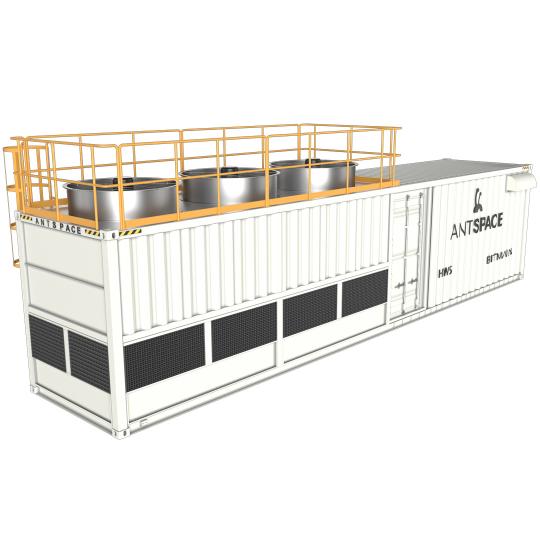
Most U.S. clients use dry coolers for heat dissipation with one 20ft liquid-cooled mining container + one or two 20ft dry coolers. Why is this? Because of climate temperature, water resources, labor costs, and construction costs. Paraguay has abundant rivers and looser environmental protection policies, so it uses closed cooling towers that cost less, provide better cooling but require a large amount of water. At the same time, the local development level is low and labor quality is also low, so the integrated design eliminates a lot of on-site installation work and greatly shortens the construction period. In most energy-cheap areas in the United States, water resources are scarce or water intake costs are high, and environmental protection requirements are strict, so using dry coolers that do not require external water sources is the optimal choice. This generates a lot of on-site installation work, but American workers can fully handle it. Using dry coolers has also become the only choice. If one dry cooler’s heat dissipation is not enough, add another. After overall stable operation, basically no maintenance is needed. The long-term ownership cost will be much lower, and the dry cooler interior contains a large amount of stainless steel and aluminum alloy, with higher recycling value than closed cooling towers.
How to Choose a Reliable Mining Container Manufacturer?
In fact, it is how to choose a reliable mining container manufacturer. When choosing a manufacturer, you must focus on these points:
- Do they have mining experience? Manufacturers without mining experience will only produce according to drawings and cannot help you design solutions—you need to be professional enough and have sufficient time yourself.
- Are they professional? Many companies are actually traders selling everything, without professional knowledge of mining farm construction. They just collect market information and give you product introductions directly. But buying a mining container is not like buying a miner—there is no standard product, and it must be customized according to the environment and climate.
- Do they have their own factory? Having a factory means they can customize containers according to your project, change configurations freely, and companies with factories will have stronger capabilities, more reasonable prices, and most importantly, reliable after-sales support. You don’t want to be unable to contact anyone after buying for a year, right?
You and your team are not omnipotent—better to research together with an experienced manufacturer. Background information must be provided; professional manufacturers will generally ask you proactively. If they don’t ask, they are not professional:
- Miner model — determines the container type (air-cooled, liquid-cooled, or immersion-cooled)
- Transformer model (if any) — determines the most suitable power consumption for a single mining container to avoid waste
- Project location — determines the year-round temperature and climate conditions
With this background information, the manufacturer can further help you design the overall solution. We will ask for the site’s floor plan based on the above information, provide a site layout diagram according to the year-round wind direction and transformer placement position, then set the appropriate single container power consumption according to the transformer model. For example, a 2600KVA transformer paired with two maximum 1MW power consumption containers is ideal and will not cause waste. We will also design the cable specifications from the transformer to the mining container. An excellent manufacturer is definitely not just selling you a product, but providing a complete set of solutions from an overall perspective.
Frequently Asked Questions (FAQ)
Why Write This Guide
Satoshi Nakamoto invented Bitcoin and also created the PoW Bitcoin mining industry. As beneficiaries of Bitcoin and one of the earliest companies engaged in Bitcoin mining farm construction, we have accumulated a lot of experience over the years. Now we see more and more new individuals and companies from other industries wanting to start Bitcoin mining, but there is no reliable information on the market to help them choose. So we wrote these words. If we really want to write it in great detail, it cannot be finished without tens of thousands of words—the selection of cables, fans, water curtains, corrugated pipe materials, corrosion inhibitors, etc. This article can only be regarded as a rough framework introduction. We hope it will be helpful to everyone.
About Us
TIANQI Mining Container, one of the world’s largest mining container manufacturers. Partners include: MARA, TDTC, Bitfarms, NYDIG, Blockfusion, Polarisdatas, Bitcluster, Bitriver, BAOHUI(Ethiopia). It is the only factory with ship classification society factory approval, the earliest company to obtain UL CSA certification, with a total building area of 13,000 square meters.